
We like to imagine artificial intelligence as something weightless: you type a sentence, and an answer appears. But pull back one layer, and it becomes physical very fast. Every token is a chip doing enormous math; every chip pulls real power; and almost every watt that goes in leaves again as heat.
For most of this industry’s history, that last step — cooling — was treated as back-office plumbing: necessary, unglamorous, and mainly a cost to minimize. I think that era is ending. As rack densities climb from tens of kilowatts toward hundreds, cooling stops being an afterthought; it becomes part of the foundation that decides whether a site can be built, how large it can become, how reliably it runs, how much water it consumes, and how much value it can create.
I’ve spent two decades moving toward this problem: from software architecture, to a decade building large-scale internet products, and since 2020, to designing and deploying liquid-cooling and heat-recovery systems for high-density compute. The work has spanned projects totaling more than 1 GW of liquid-cooled capacity, and heat-recovery systems serving more than 2 million square meters of homes, greenhouses and industrial facilities. The throughline is simple: the waste heat of computing is not waste. At the right temperature, with the right system design, it becomes an asset.
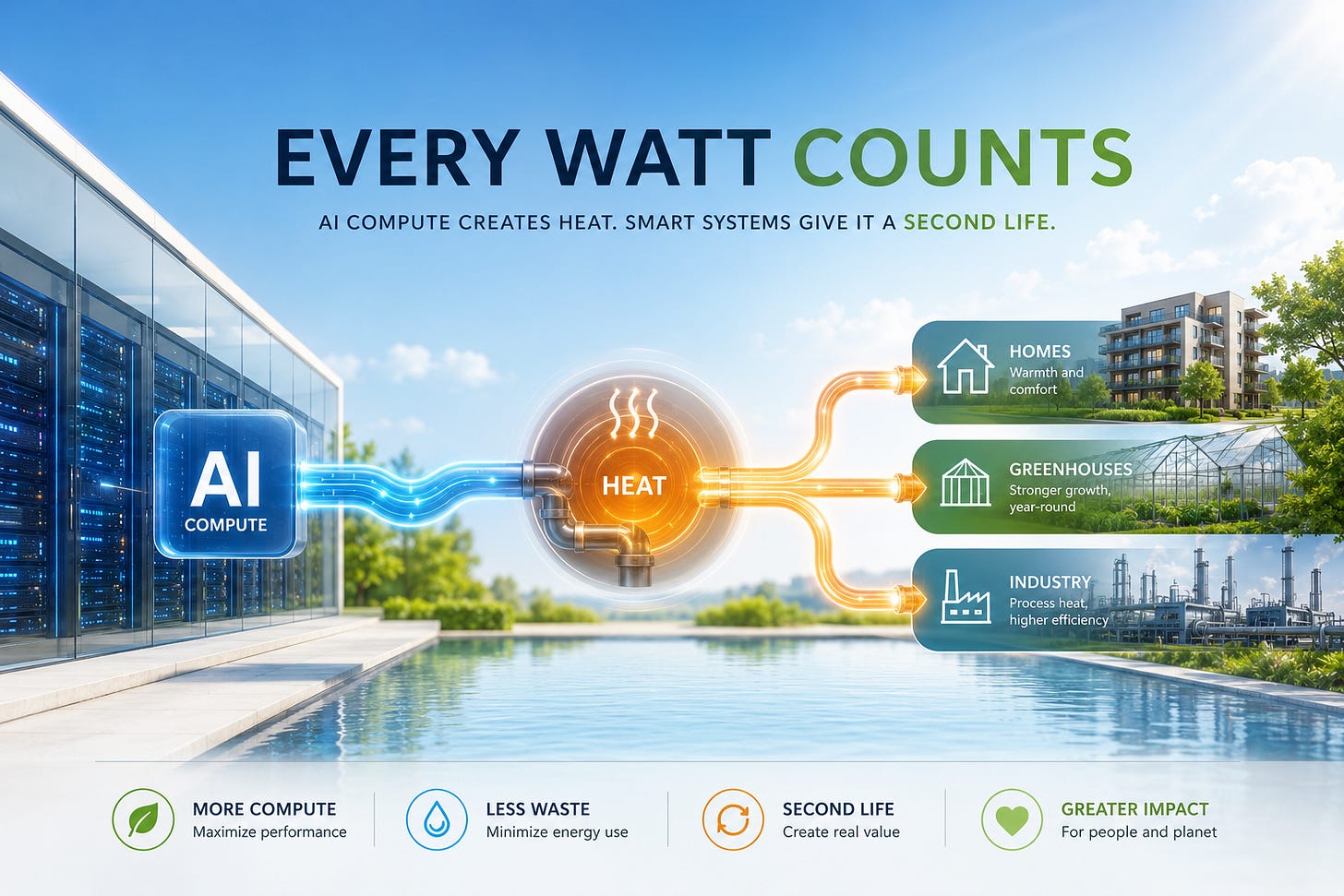
The whole idea fits in one line: AI compute creates heat, and smart systems give it a second life. That same heat can become warmth and comfort for homes, year-round growth in greenhouses, and process heat that makes industry more efficient. The pipe between “compute makes heat” and “communities use heat” is the most underrated opportunity of the coming decade.
This publication is where I’ll think out loud about that. Expect essays on liquid cooling — and why warmer water, not colder water, is the real unlock; the economics of turning reject heat into revenue; the energy and grid story underneath the AI buildout; and the engineering details that decide whether any of it actually works.
I’ll also serialize my book, The Liquid Cooling Revolution, chapter by chapter — starting with where this all came from, and how a sixty-year-old “old technology” suddenly became unavoidable.
My north star is on the masthead — make every watt count: more compute, less waste, a second life for the heat, and greater impact for people and planet.
If that’s your kind of question, subscribe. I’d be glad to have you along.
— Jim
By Jim Li, founder of NextGenergy. First published on Substack. Discuss it there or on LinkedIn. Markdown version.