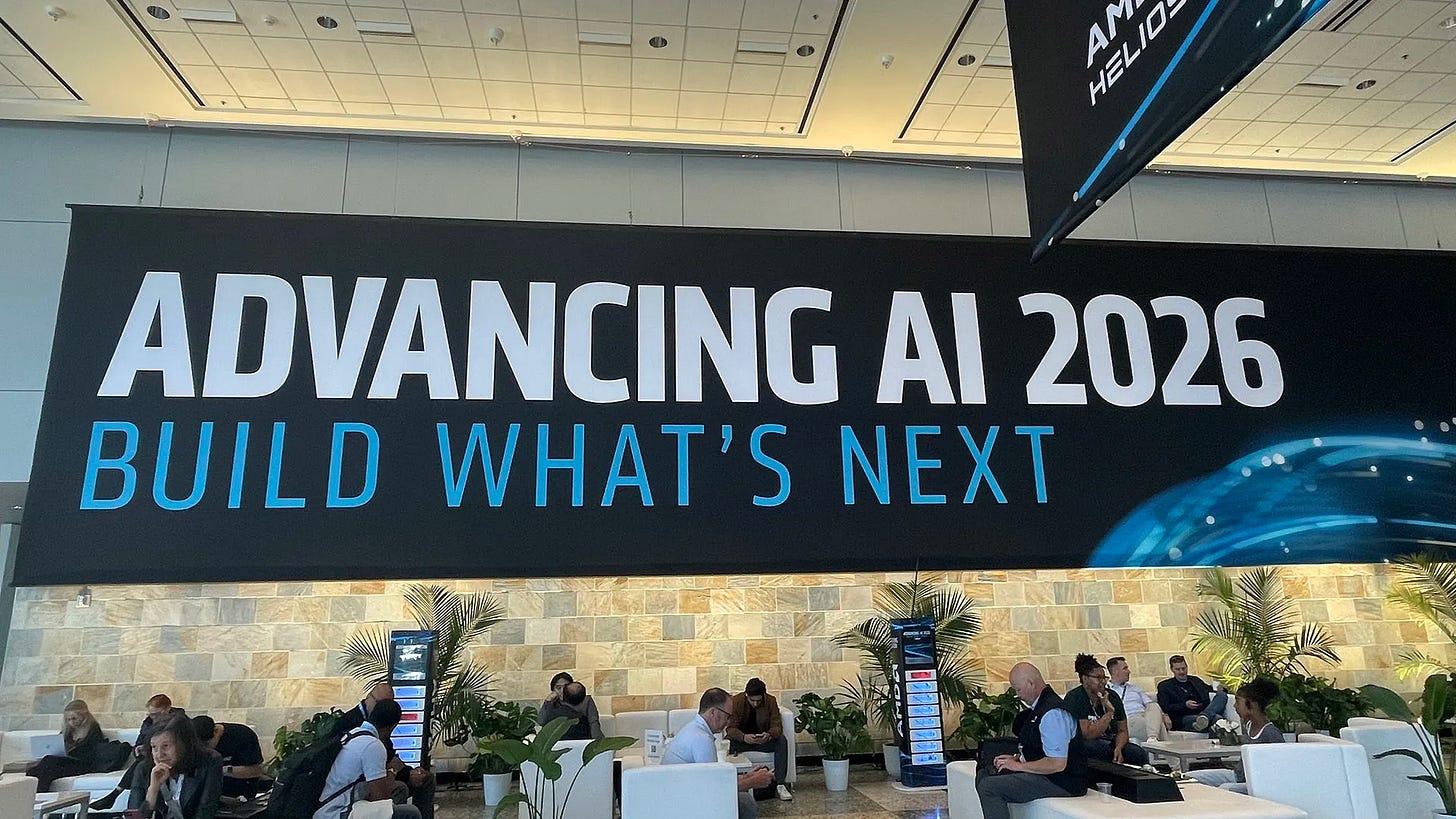
AMD Advancing AI 2026, San Francisco
On July 22, I arrived in San Francisco for the two-day AMD Advancing AI 2026 conference. Over the course of the event, I examined the Helios rack-scale systems on display—including a Wiwynn implementation based on the Helios architecture—and listened to AMD experts unpack the platform’s compute architecture, GPU interconnect, networking, memory and system design.
Standing in front of the hardware, my first reaction was not that AMD had simply launched a faster GPU.
The more consequential development was that AMD had begun to organize CPUs, GPUs, networking, software, power, liquid cooling and rack design as one co-optimized system. That is a different arena from the traditional contest over individual chips.
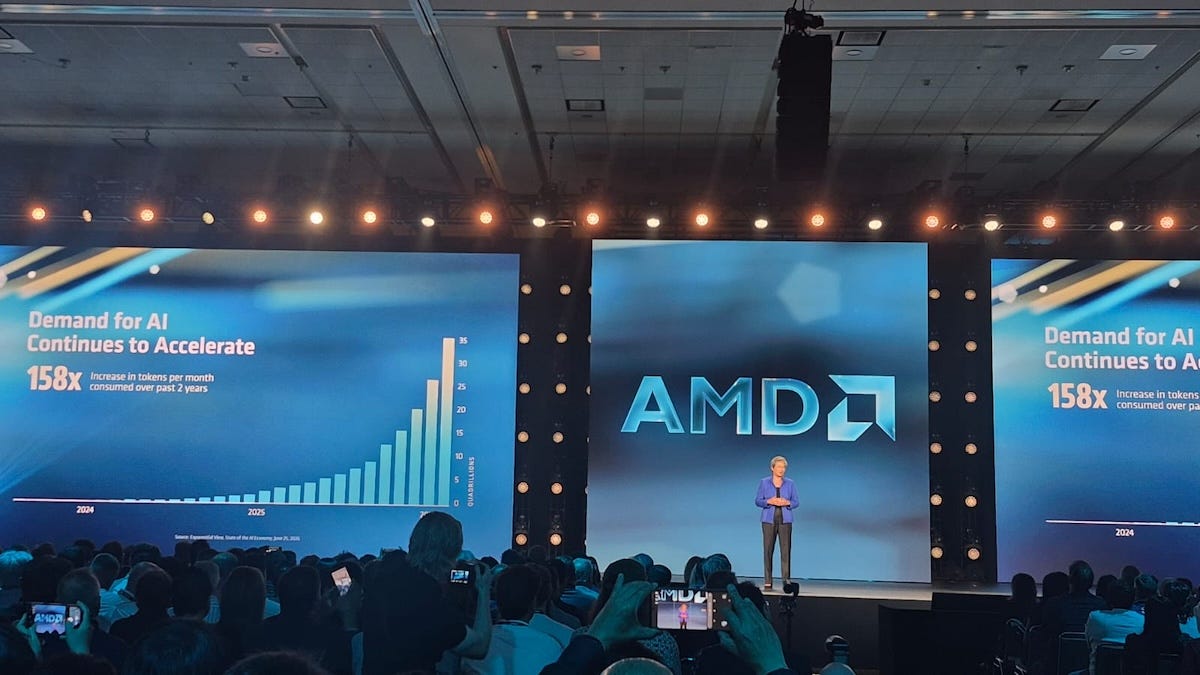
AMD Chair and CEO Lisa Su delivers the keynote at Advancing AI 2026
Three signals from Helios
At first glance, Helios is a new high-density AI rack-scale platform. Reducing it to compute, memory and bandwidth figures, however, misses its larger significance.
-
At the product level, AMD is extending the boundary of the AI product from the chip and server node to the entire rack.
-
At the company level, AMD is moving beyond a silicon- and node-platform-led role toward becoming an architect and ecosystem orchestrator for rack-scale AI infrastructure.
-
At the industry level, AMD is attempting to establish an open, multi-vendor rack-scale alternative to NVIDIA’s vertically integrated model.
1. The unit of AI infrastructure is shifting from the GPU to the rack
AI hardware discussions used to begin with the individual GPU: compute, memory capacity, bandwidth and power. For frontier-model training and large-scale inference, however, the performance of a single accelerator no longer determines the performance of the system.
The relevant questions have moved up a level. Can dozens of GPUs behave as one coherent resource? How do they scale up inside the rack and scale out across racks? How efficiently does data move? How are CPUs, GPUs and networks coordinated? Are power, cooling and serviceability designed into the platform from the start?
Helios is AMD’s answer to that combined problem.
AMD’s current reference design integrates 72 AMD Instinct MI455X GPUs, 6th Gen AMD EPYC processors code-named “Venice,” AMD Pensando “Vulcano” networking and the ROCm software stack. Each MI455X carries 432 GB of HBM4, providing roughly 31 TB per rack. AMD lists peak theoretical performance of up to 2.9 exaFLOPS at FP4 and 1.4 exaFLOPS at FP8.
Four scale-up cartridges use Ultra Accelerator Link over Ethernet, or UALoE, to connect the GPUs, with up to 260 TB/s of aggregate scale-up bandwidth. AMD also lists up to 43 TB/s of scale-out bandwidth through its Pensando-based networking. These are peak or theoretical specifications—not guarantees of application-level performance.
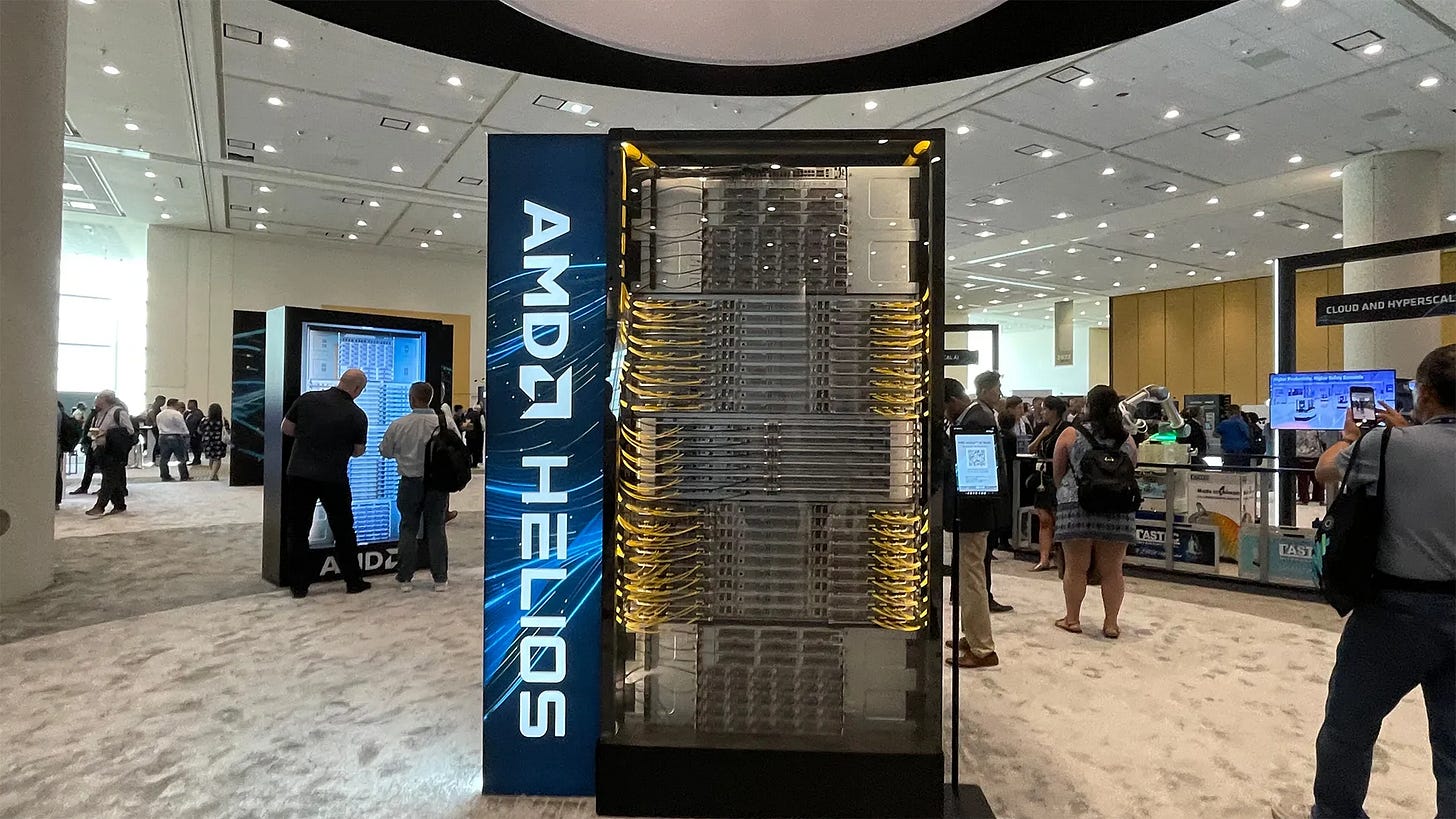
An AMD Helios rack-scale system on display at Advancing AI 2026
The point is not merely that AMD has placed 72 GPUs in one enclosure. Helios treats compute, memory, interconnect, networking, software, power, liquid cooling and serviceability as a single design domain.
Physically, Helios is a rack. Architecturally, it is closer to a data-center-scale computer.
One distinction matters: Helios is not a finished rack sold directly by AMD. AMD describes it as the company’s first rack-scale AI reference design. OEM and ODM partners use that blueprint to develop, manufacture and deliver their own systems. AMD is defining the core architecture and interfaces while relying on an ecosystem for switches, manufacturing, customer adaptation and deployment.
2. AMD has built platforms before—Helios moves the platform boundary to the full rack
It would be inaccurate to portray AMD’s previous role as simply selling CPUs and GPUs.
AMD has spent years building system-level capabilities. EPYC is established across cloud, enterprise and high-performance computing. Instinct MI250X accelerators helped power Frontier. The MI300X Platform brought eight GPUs together in an OCP-based node-level design. ROCm has long been AMD’s open software foundation. The 2022 acquisition of Pensando added DPUs, networking and infrastructure software, while Xilinx brought FPGAs, adaptive SoCs and their associated software assets.
Helios is therefore not the moment AMD abruptly changed from a chip company into a systems company. The more accurate progression is from CPU and GPU supplier, to node-level platform supplier, and now toward rack-scale architecture owner and ecosystem orchestrator.
AMD’s 2025 acquisition of ZT Systems was pivotal. ZT brought rack-scale design, validation and customer-enablement experience for hyperscale environments. AMD retained those design and customer-enablement capabilities while divesting the manufacturing business. That structure suggests AMD wants to own more of the architecture, validation and customer co-design without becoming a conventional server manufacturer.
AMD no longer wants its silicon merely installed inside an AI system defined by someone else. It wants a role in defining the system itself.
3. Helios is an attempt to build an open rack-scale AI path
NVIDIA’s advantage in AI has never rested on the GPU alone. It is the combined effect of GPUs, NVLink, networking, CUDA, system architecture and deployable rack-scale products. Customers buy an operating platform—not an isolated chip.
Helios is AMD’s attempt to compete at that level. It adopts Meta’s Open Rack Wide specification submitted to the Open Compute Project and combines it with UALink, UALoE and Ethernet-based scale-out networking. The objective is an open architecture in which multiple silicon, networking, system and infrastructure suppliers can participate.
“Open” here describes an industrial model as much as a technical standard. AMD defines the CPU, GPU, networking and reference architecture. Large customers influence standards and workload optimization. Celestica is developing and manufacturing scale-up switches. Sanmina, Wiwynn, Wistron and Inventec are among the manufacturing partners. OEMs such as HPE can turn the reference design into customer-facing products.
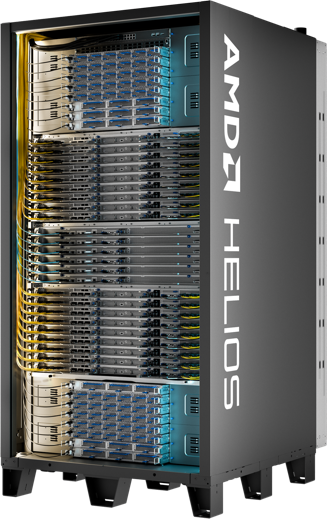
AMD Helios rack-scale reference design. Image: AMD
From technical launch to gigawatt-scale commitments
An open architecture matters only if it achieves commercial scale.
OpenAI and Meta have each entered multi-year, multi-generation agreements with AMD covering up to 6 GW. Anthropic plans to deploy up to 2 GW of AMD Instinct MI450 Series GPUs. Oracle has announced an initial deployment of 50,000 MI450 Series GPUs beginning in the third quarter of 2026.
Those figures should not be read as capacity already installed, nor should they be taken to mean that every deployment will use the identical 72-GPU MI455X reference configuration. Meta’s first phase uses a custom GPU based on the MI450 architecture, while the other announcements generally use the broader “MI450 Series” designation.
Even with those qualifications, the commitments show that Helios is no longer merely an engineering concept. It is becoming the central vehicle for AMD’s push into large-scale AI infrastructure.
Helios could redistribute value—and responsibility—across the supply chain
If Helios scales successfully, its effects will extend beyond the accelerator market. It could redraw boundaries among server vendors, networking suppliers, liquid-cooling companies, electrical-infrastructure providers, integrators and data-center operators.
Once rack power moves beyond 200 kW, power and cooling cannot be designed after the compute platform has been selected. Rack geometry, structural loading, busways, CDUs, manifolds, quick disconnects, supply and return temperatures, flow, pressure drop, residual air-cooling load, leak detection and controls all become part of the platform conversation.
Data-center infrastructure is no longer merely the building that houses the compute product. It is becoming part of the compute product.
The role of the server vendor also expands—from manufacturing and assembly to system validation, factory acceptance testing, commissioning, warranty integration and lifecycle service.
For cooling and electrical-infrastructure companies, the opportunity is no longer limited to selling a CDU, cold plate or power-distribution package. The larger opportunity is to enter the AI platform’s design and delivery process much earlier.
A NextGenergy perspective: liquid cooling is entering the definition of the compute platform
NextGenergy has spent six years working in liquid cooling.
Over that period, we have watched liquid cooling move from a specialized requirement in a limited number of HPC projects to a prerequisite for high-density AI data centers. Helios represents a deeper shift than simply putting more servers on liquid.
At rack power levels above 200 kW, cooling is no longer equipment added after the server is designed. It influences GPU placement, rack geometry, electrical architecture, network connections, service procedures and the design envelope of the facility itself.
Liquid cooling is no longer only a way to remove heat from chips. It is becoming part of how the next generation of AI platforms is defined.
That is what makes AMD’s move especially important to us at NextGenergy. The question is not only which GPU wins more market share. It is whether an open rack-scale architecture can bring compute vendors, OEMs, liquid-cooling specialists and data-center operators into the design process earlier—with clear, repeatable technical interfaces and delivery boundaries.
If that coordination matures, the value of the cooling industry will extend beyond CDUs, cold plates and piping. It will include site readiness, rack-to-facility liquid interfaces, prefabricated power and cooling modules, factory acceptance testing, commissioning, operations, availability, warm-water cooling and heat reuse.
For NextGenergy, this is both validation and responsibility. Six years of liquid-cooling experience must now be translated into the engineering and delivery capability required to bring the next generation of AI platforms online quickly and reliably.
Openness creates choice—and integration risk
One of the most compelling claims around Helios is openness. But open does not automatically mean easy.
A vertically integrated platform concentrates accountability. An open platform requires multiple suppliers to prove interoperability and define who is responsible for performance, reliability and service at the system level.
Helios will therefore be judged by more than MI455X benchmark results. ROCm must continue closing ecosystem gaps. UALink and UALoE must prove themselves in production at scale. OEMs and ODMs must deliver consistent quality. Power, cooling and controls interfaces must become repeatable. Multi-vendor warranty and service boundaries must be clear.
If those pieces come together, Helios could become the first truly scaled rack-level template for open AI infrastructure. If they do not, it could remain a technically impressive reference architecture burdened by integration complexity.
The real conclusion
What stayed with me after leaving AMD Advancing AI 2026 was not any single Helios specification. It was the realization that the unit of competition in AI infrastructure has changed.
AMD is not entering platforms for the first time, and it has not suddenly transformed from a chip company into an infrastructure company. What it has done is bring years of CPU, GPU, networking, software and system-design investment together in its first full rack-scale AI reference architecture.
For AMD, that is a significant move from silicon and node-level platforms toward rack-scale architectural leadership. For large AI customers, it creates the possibility of a more complete and open alternative to NVIDIA’s stack. For companies such as NextGenergy, it brings liquid cooling, power, field integration and heat reuse into the definition of the compute platform—not merely into the later stages of the facility project.
For six years, our work has focused on moving heat safely and efficiently away from the chip. Helios reinforces a broader conclusion: the next challenge is not simply how to cool a server. It is how to design compute, power, liquid cooling and the data center as one system from day one.
Helios has not reshaped the industry yet. But it has elevated the question: who will define, integrate, deliver and ultimately stand behind the next generation of AI infrastructure?
That is the real shift I saw in San Francisco.
— Jim Li, founder of NextGenergy, focuses on power, cooling, and energy reuse for AI compute infrastructure. He is working to move next-generation AI data centers beyond single-point equipment optimization toward integrated system design across power, liquid cooling, and heat recovery.
Primary sources
By Jim Li, founder of NextGenergy. First published on Substack. Discuss it there or on LinkedIn. Markdown version.